Science News Archive
Science News
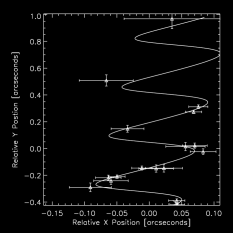
1 Feb 2010 Parallax measurement of the first
T9 brown dwarf discovered, ULAS J0034-0052, by Ricky Smart,
Torino. The measured distance of 12.6+/-0.6pc allows the
measurement of the source's bolometric luminosity, and confirms the
very cool temperature of 550-600K previously inferred from
spectroscopic modelling. The source is the coolest brown dwarf
known with a directly measured parallax.The parallax program will
lead to measurements for several more UKIDSS brown dwarfs over 2010
and 2011. For further info see the
press release (in Italian).

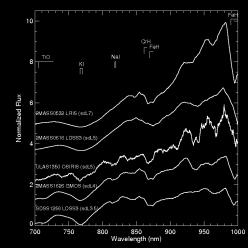
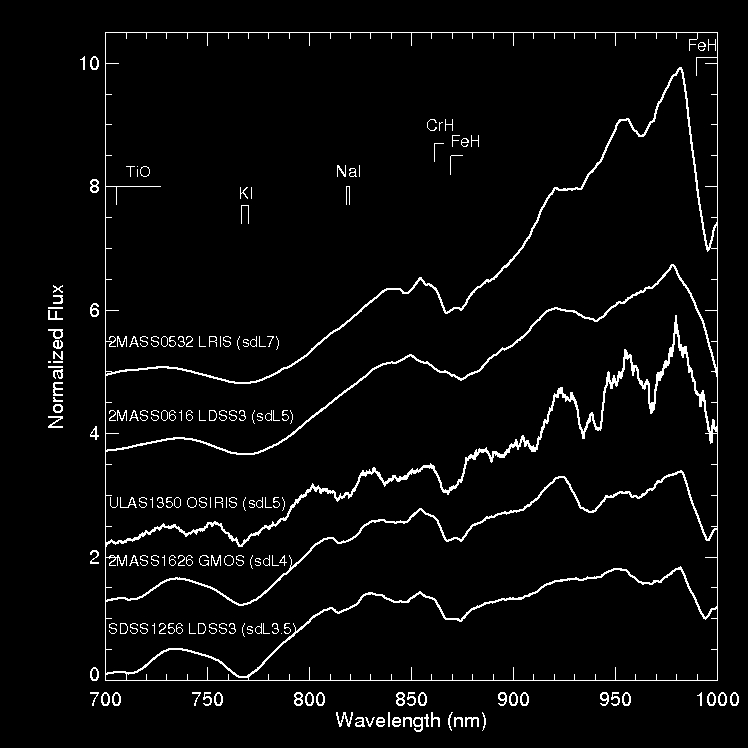
18 Dec 2009 Optical spectrum of the new L
subdwarf ULAS1350 (middle spectrum - click for larger version),
obtained with the OSIRIS spectrograph on the 10.4-m Gran
Telescopio de Canarias (GTC). This object was identified
photometrically, by Lodieu and collaborators, in a search of a 234
sq. degs region common to the Sloan Digital Sky Survey and the
UKIDSS Large Area Survey. This is the fifth L subdwarf known to
date, the first one discovered in UKIDSS, and the furthest
known. Fur further info see the
press release.
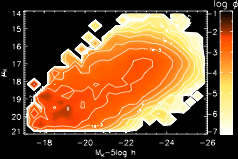
1 Oct 2009
The bivariate brightness distribution for a sample of 40,111 galaxies
in the UKIDSS Large Area Survey (Smith et al. 2009, MNRAS, 397, 868).
The shaded regions show how the number of galaxies per unit volume
depends on the galaxies' K-band luminosity (increasing towards the
right) and surface brightness (increasing towards the top). It can be
seen that there is a strong correlation between surface
brightness and luminosity, and that this correlation flattens at high
luminosity. This can be used to inform our understanding of how galaxies form.
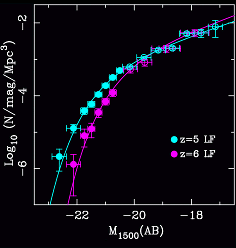
16 Jul 20009
Evolution of the galaxy luminosity function between z=5 and z=6
(McLure et al. 2009, MNRAS 395, 2196). The plot combines
data from the UKIDSS Ultra-deep survey at the bright-end, L>L*,
with the results from deep Hubble Space Telescope (HST) images for
the faint end, to cover a wide luminosity range (0.1L* < L < 10L*)
at z=5 and z=6. In the redshift interval 5 < z < 6 the galaxy
luminosity function appears to undergo simple luminosity
evolution, with L* dimming by a factor of ~2 from z=6 to z=5.
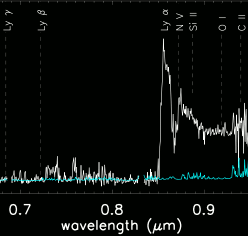
27 May 2009
Gemini GMOS-N spectrum of the newly discovered quasar ULAS J1207+0630, with
redshift z=6.04, from DR5. The object is detected in z in SDSS,
but lies just below the S/N cut of the SDSS quasar searches. The
absorption complex just blueward of the NV emission line is
resolved into a set of NV doublets.
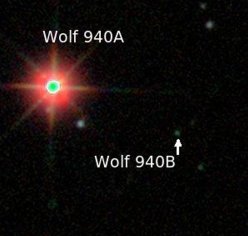
20 Apr 2009
Discovery of Wolf 940B, a very cool brown dwarf in a binary
system, announced in a
press release today. The brown
dwarf is one of the coolest known with effective temperature 570K,
adding to the handful of extreme cool brown dwarfs discovered by
UKIDSS. Wolf 940B is the first such object discovered in a binary
system, providing an accurate distance measurement. This allows
a stringent test of theoretical brown dwarf spectra, and suggests
a revision of the temeprature scale to cooler tmeperatures.
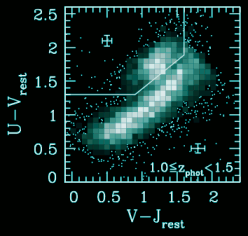
12 Feb 2009 Bimodality of restframe galaxy colours
(from Williams et al 2009 ApJ 691). Restframe U-V and V-J colours and
photometric redshifts were computed for 30,108 galaxies in the UKIDSS
UDS. In the U-V vs V-J diagram galaxies separate into two sequences,
an upper sequence of passive galaxies, and a lower sequence of
star-forming galaxies, of increasing dust content from lower left to
upper right. The bimodality is clearly seen up to z=2.
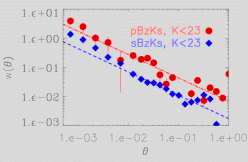
13 June 2008 The clustering of BzK galaxies (Hartley
et al., in prep.). Galaxies in the UDS have been selected to lie in
the redshift range 1.4 < z < 2.5 and can be characterised as either
star-forming (sBzK) or passive (pBzK) by the Daddi et al. (2004)
criterea. In this redshift range it is the passive galaxies that are
found to be the more highly clustered. The clustering of a set of
galaxies can be directly linked to the mass of the dark matter halos
in which they reside; in the case of the pBzKs the dark matter halos
have mass in excess of 1013 solar masses.
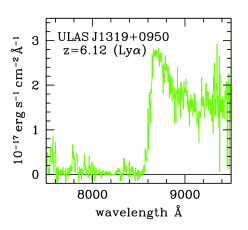
24 January 2008 A recently discovered high-redshift
quasar in the LAS, ULAS J131911.29+095051.4 (Mortlock et al., in
prep). The redshift has been estimated from the wavelength at which
absorption to the blue of the emission line cuts on, and assuming this
point to be the centre of the Lya emission line. The source has i(AB)=22.6,
Y=19.2, J=18.8.
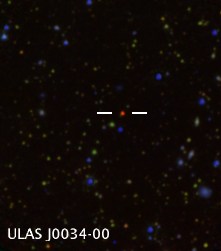
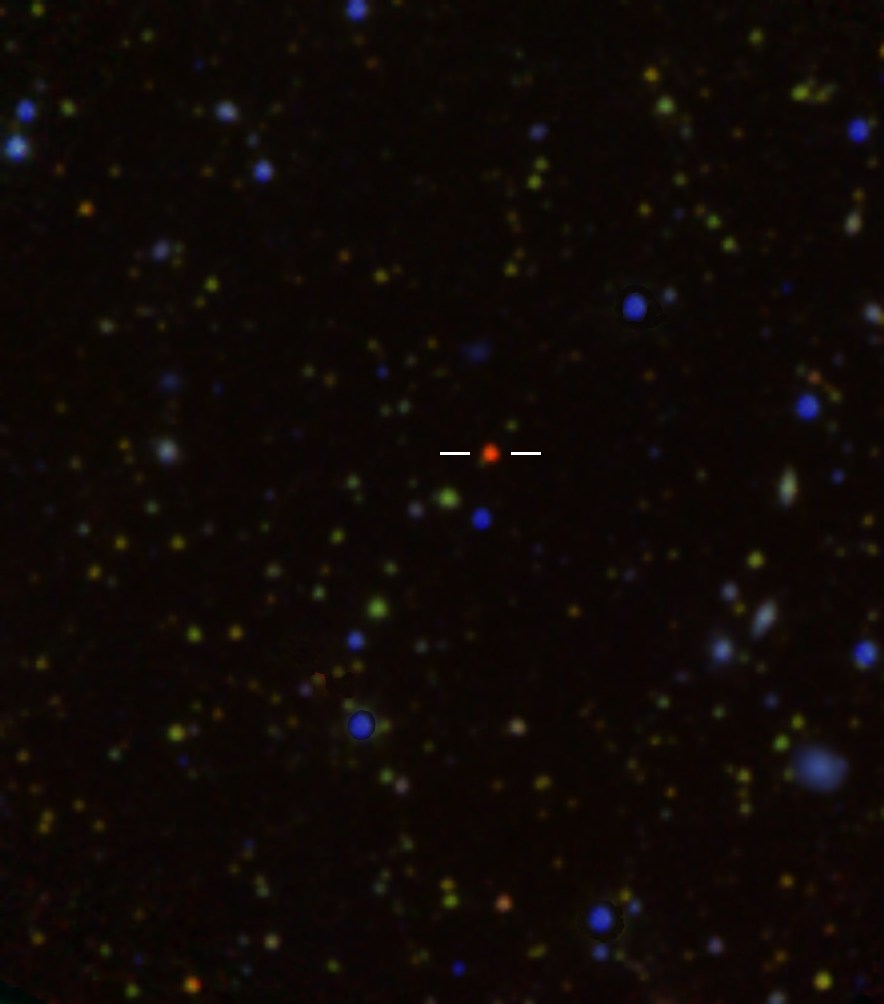
1 June 2007 Spitzer view of the cool brown dwarf
ULAS J0034-00. In this rgb image, the blue channel is the z band,
and the green and red channels are Spitzer channels 1 and 2 (3.55
and 4.49 um). Therefore main-sequence stars, relatively faint in
the mid-ir, appear blue.