Legacy site: modern website will appear in due course
 UKIDSS is the next generation near-infrared sky
survey, the successor to 2MASS. UKIDSS began in May 2005 and will
survey 7500 square degrees of the Northern sky, extending over
both high and low Galactic latitudes, in JHK to K=18.3. This depth
is three magnitudes deeper than 2MASS. UKIDSS will be the true
near-infrared counterpart to the Sloan survey, and will produce as
well a panoramic clear atlas of the Galactic plane. In fact UKIDSS
is made up of five surveys and includes two deep extra-Galactic
elements, one covering 35 square degrees to K=21, and the other
reaching K=23 over 0.77 square degrees. UKIDSS is the next generation near-infrared sky
survey, the successor to 2MASS. UKIDSS began in May 2005 and will
survey 7500 square degrees of the Northern sky, extending over
both high and low Galactic latitudes, in JHK to K=18.3. This depth
is three magnitudes deeper than 2MASS. UKIDSS will be the true
near-infrared counterpart to the Sloan survey, and will produce as
well a panoramic clear atlas of the Galactic plane. In fact UKIDSS
is made up of five surveys and includes two deep extra-Galactic
elements, one covering 35 square degrees to K=21, and the other
reaching K=23 over 0.77 square degrees.
The survey instrument is WFCAM on the UK Infrared
Telescope (UKIRT) in Hawaii. WFCAM has four 2048x2048 Rockwell
devices, at 94% spacing, as illustrated at the top. The pixel
scale of 0.4 arcsec gives an exposed solid angle of 0.21
sq. degs.
Four of the principal quarry of UKIDSS are: the
coolest and nearest brown dwarfs, high-redshift dusty starburst
galaxies, elliptical galaxies and galaxy clusters at redshifts
1‹z‹2, and the highest-redshift quasars, at z=7. UKIDSS
aims to discover the nearest object to the Sun (outside the
solar system) as well as some of the farthest known objects in the
Universe.
The UKIDSS Consortium is a collection of some 100
astronomers who are responsible for the design and execution of
the survey. The data become available to the entire ESO community
immediately they are entered into the archive. Release to the world follows
18 months after each release to ESO.
|
Science News
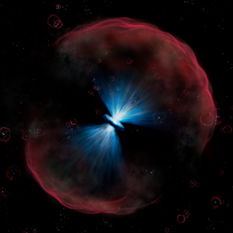
 30 Jun 2011: Discovery of the first quasar with
a redshift z>7 (artist's impression by Lynette Cook / Gemini). The source ULAS J1120+0641 z=7.085 hosts a black hole of
2 billion solar masses. Most interestingly the
transmission spectrum around Lya has the
characteristic profile of the predicted red damping wing of the
inter-galactic medium. It appears that this is the first quasar
discovered in the epoch of reionisation. For further info see the
press releases from Gemini
and ESO . 30 Jun 2011: Discovery of the first quasar with
a redshift z>7 (artist's impression by Lynette Cook / Gemini). The source ULAS J1120+0641 z=7.085 hosts a black hole of
2 billion solar masses. Most interestingly the
transmission spectrum around Lya has the
characteristic profile of the predicted red damping wing of the
inter-galactic medium. It appears that this is the first quasar
discovered in the epoch of reionisation. For further info see the
press releases from Gemini
and ESO .
Science
News archive
|
|
 1 Jan 2013 UKIDSS' 400th journal paper has appeared in press.
1 June 2012 Talks now online from workshop "Science from
UKIDSS IV"
22 May 2012 UKIDSS observations were completed today
 25 Oct
2011 Euro Release of LAS, GCS, DXS DR9 took place
today (current GPS, UDS is DR8).
25 Oct
2011 Euro Release of LAS, GCS, DXS DR9 took place
today (current GPS, UDS is DR8).
25 Apr
2012 World Release of UKIDSS DR8 .
|







 Queries, suggestions to:
  The
The 